Gold Lab
How to read a gold hallmark: the complete tutorial
By NorwegianSpark Editorial — written with AI assistance and reviewed by the NorwegianSpark SA editorial team | Last updated: September 2026
Before you start
Most gold jewellery and bullion carries a small stamp. Once you know how to read it, you can tell within thirty seconds whether you are holding 9-carat budget jewellery, 18-carat fine gold, or something close to pure investment-grade metal. You can also spot the most obvious fakes.
This is the practical version. No history of medieval assay offices, no detour through silver markings. Just what the numbers mean and how to find them.
You will need: a jeweller's loupe (10x is the standard) or a strong magnifying glass, and good light. A phone torch works.
Step 1 — Find the hallmark
The hallmark is almost always in a hidden but accessible place. Manufacturers hide it because it would ruin the look of the piece if stamped on the front, but they put it somewhere you can find without dismantling anything.
Where to look first:
- Rings — inside the band, opposite the stone or design
- Necklaces and bracelets — on the clasp itself, or on a small flat tag near the clasp
- Earrings — on the post (stud earrings) or the back of the catch (hoops)
- Watch cases — inside the case back, sometimes around the lugs
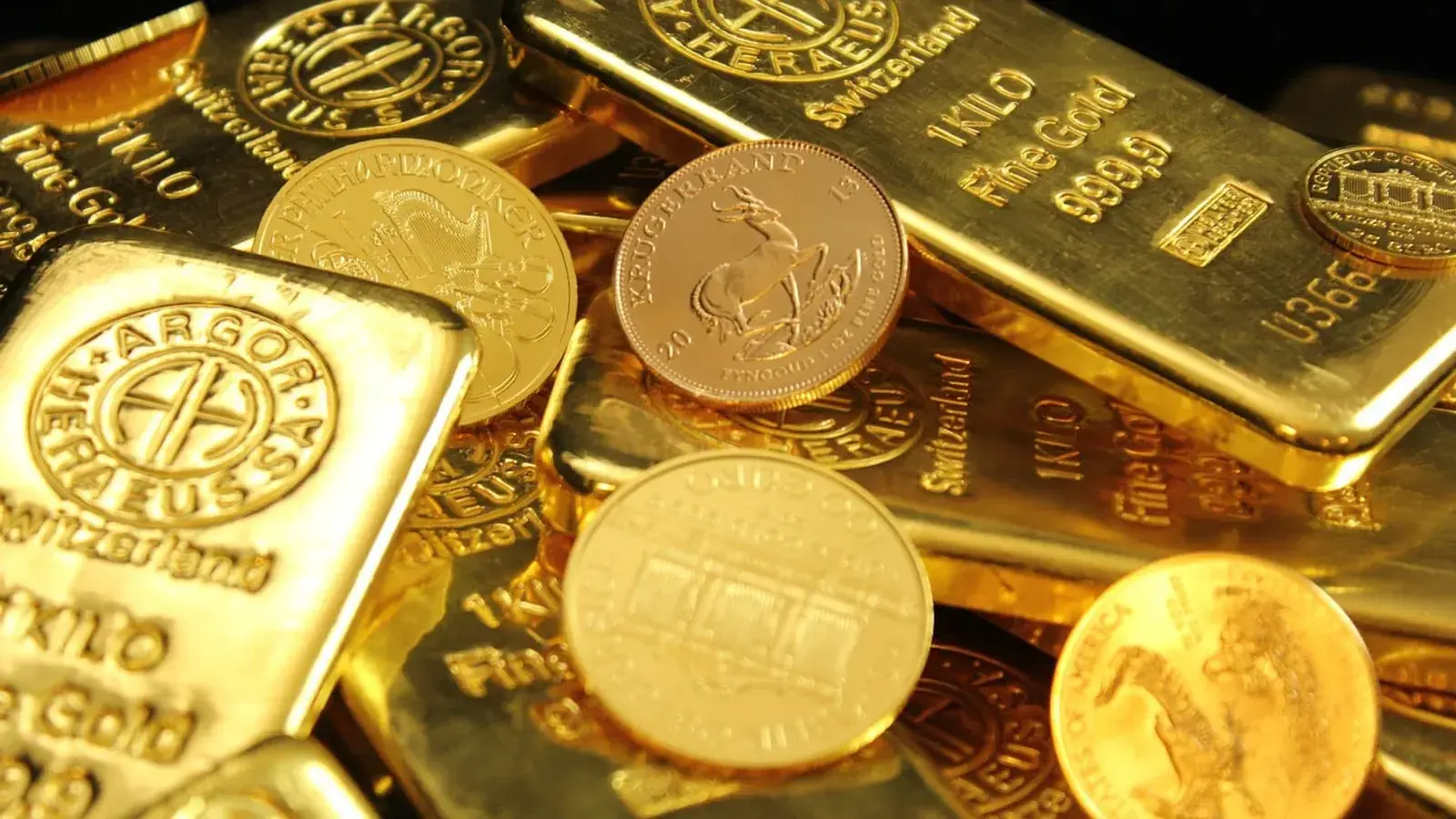
- Gold bars and ingots — stamped directly on the face, alongside the weight, fineness, and serial number
- Coins — milled into the rim, or part of the obverse design
If you find nothing in those places, the piece may still be gold (older or imported pieces sometimes lack hallmarks). We will cover unmarked pieces at the end.
Step 2 — Identify the fineness number
The most important mark is the fineness number — three digits that tell you exactly how much pure gold is in the piece. This is the millesimal system — in the UK the number became a compulsory part of the hallmark in 1999, and France has required fineness in thousandths since 1995. The number is parts per thousand of pure gold. So "750" means 750 parts gold out of 1,000, or 75% pure gold.
Here is the table to memorise. These are the fineness numbers you will meet most often — others exist, such as 990 and 995 on bullion and 833 and 958 on Indian jewellery:
- 999 — 99.9% gold — 24K — Investment bullion, ingots, Asian wedding gold
- 916 — 91.6% gold — 22K — Indian, Middle Eastern, traditional Asian jewellery
- 875 — 87.5% gold — 21K — Common in Gulf states
- 750 — 75.0% gold — 18K — European fine jewellery, Swiss watches
- 585 — 58.5% gold — 14K — Most common in US and Northern Europe
- 417 — 41.7% gold — 10K
- 375 — 37.5% gold — 9K — UK, Australia, Ireland, France minimum
- 333 — 33.3% gold — 8K — Germany, Denmark minimum
Anything stamped lower than 333 is not legally gold in most countries — you are looking at gold-coloured alloy.
If you see a karat mark instead — "18K", "14kt", "9ct" — it means the same thing. 18K and 750 are identical. Some pieces, especially modern ones aimed at international markets, carry both ("18K 750"). That is normal and reassuring, not redundant.
Step 3 — Check for the maker's mark
Next to the fineness number, you will often see a small symbol, set of initials, or logo. This is the maker's mark (also called the sponsor's mark). It identifies the manufacturer or designer.
Maker marks are useful for three reasons. First, recognised maker marks add resale value. A Cartier mark on an 18K piece is worth substantially more than the same gold weight from an unknown maker. Second, the maker mark verifies the piece against the manufacturer's records if you need to authenticate it later. Third, fake hallmarks usually have fake or missing maker marks — the forger gets the fineness number right and then leaves the rest blank or invents a logo.
You do not need to memorise maker marks. If a piece has any maker mark at all, that is a positive signal. If you want to identify a specific mark, search "[mark text] gold maker mark" and you will usually find a directory match.
Step 4 — Check for the assay office mark
UK-hallmarked gold has an additional small symbol indicating which assay office tested it. The four UK offices are:
- Leopard's head — London
- Anchor — Birmingham
- Rose — Sheffield
- Castle (three-towered) — Edinburgh
This mark is meaningful evidence of authenticity. The UK requires by law that any gold item over a certain weight threshold be hallmarked before it is sold as gold — by one of these four offices or with a legally recognised Convention hallmark from another member country. A piece with both a fineness number AND an assay office mark has been independently verified by a third party — that is the strongest authentication signal you will get from looking at the piece alone.
EU countries use national systems with their own assay symbols. France uses an eagle's head for 18K. Switzerland uses a Helvetia head or St Bernard. Germany has historically been less strict — many German pieces show only the fineness number.
If a piece claims to be UK-hallmarked but has no assay office mark, treat the claim with suspicion.
Step 5 — Check for the date letter
Full UK hallmarks include a date letter — a single letter inside a shaped frame indicating the year the piece was assayed. The cycle resets approximately every 25 years and changes typography between cycles, so a 1975 "A" looks different from a 2000 "A".
You do not need to decode this in the field. If you want the exact year, look up "UK hallmark date letter chart" — there are reliable references online and the system is well-documented.
The date letter is useful primarily for resale and insurance valuation, and for distinguishing genuine vintage pieces from modern reproductions.
A worked example
You pick up a ring at an estate sale. Inside the band, with a loupe, you see four small stamps in a row.
The first is a square shape containing two initials, "MG". That is the maker's mark — Marcus Grant (made up, but the format is correct).
The second is a small leopard's head. Hallmarked in London.
The third is the number 750. The ring is 18-karat gold, 75% pure.
The fourth is a letter "P" in a curved frame. London hallmark cycle date letter for 2014.
You now know: this is an 18K gold ring, made by maker MG, hallmarked in London, tested in 2014. The combination of fineness number plus London assay mark plus date letter is the highest evidence of authenticity you will get from inspection alone. You can value it confidently against the spot price of 18K gold for its weight.
What to do when there is no hallmark
Many pieces of real gold have no hallmark. The most common reasons:
- Age — pieces predating modern hallmarking laws often have no stamp
- Origin — gold from countries without strict hallmarking traditions (much of Asia and Africa)
- Customisation — pieces resized or repaired sometimes lose their original hallmark
- Handmade — small workshops may sell unhallmarked gold legally below the weight threshold
Unmarked does not mean fake. But it does mean you cannot verify the piece by inspection alone. Your options:
Acid test kit — applies a drop of acid to a tiny scratch on the piece. Different acid strengths react with different gold purities. Destructive on a small scale (you make a tiny mark), but the most accessible way to verify at home. Honest gold dealers will do this for free if you are considering buying from them.
Electronic gold tester — non-destructive, measures conductivity. Faster than acid testing, no marks left on the piece. Less accurate on thin gold plating.
XRF analyser — what jewellers and pawn shops use. Non-destructive, measures composition by X-ray fluorescence. Highly accurate. Not portable in your pocket, but most jewellers will run a piece through their XRF for a small fee or for free if you are selling.
Specific gravity test — works at home with a kitchen scale and a glass of water. You weigh the piece dry, then suspended in water, and calculate density. Pure gold has a density of 19.3 g/cm³, which is dramatically higher than almost any other metal you might be looking at. This is a useful sanity check on bullion. It is harder on jewellery because gemstones and complex shapes throw off the calculation.
Quick fraud checks before you bother with tests
Most fake "gold" can be ruled out in seconds without any equipment:
- Magnetism — real gold is not magnetic. If a fridge magnet pulls it, it is not gold (or it has a steel core, which is sometimes worse).
- Weight — gold is heavy. A solid gold piece feels noticeably denser than a costume jewellery piece of the same size. Practice by weighing a known piece, then compare.
- Discoloration on skin — real gold does not turn your skin green or your sweat brown. Most cheap "gold-plated" jewellery does, especially in the first few wearings.
- Wear pattern — gold plating wears off at edges and contact points, exposing a different colour underneath. Solid gold wears uniformly because it is the same metal throughout.
- "GP", "GF", "HGE" stamps — these mean "gold plated", "gold filled", and "heavy gold electroplate" respectively. The piece is not solid gold. The base metal underneath has minimal resale value.
Putting this into practice
The next time you handle a piece of gold — whether it is your own, a piece you are considering buying, or something you have inherited — go through this in order:
- Find the hallmark (Step 1)
- Read the fineness number (Step 2)
- Note the maker's mark if present (Step 3)
- Check for an assay office mark if UK (Step 4)
- If unmarked, run the quick fraud checks, then consider an acid or XRF test
That is the entire process. Most pieces will be readable in under a minute. The few that need testing are the ones where it matters most to know what you actually have.
For buying investment gold where you want zero ambiguity, the cleanest route is to buy from dealers whose pieces arrive with full assay certificates and serial numbers stamped on the bar itself. Check the dealer's delivery terms for your country first: Silver Gold Bull, for example, currently accepts orders from outside North America only for secure storage, not physical delivery. For wearable investment gold with Asian-market resale liquidity, Chow Sang Sang sells gold ingots and high-purity gold jewellery, and in Hong Kong a retailed gold article must carry a fineness mark and an invoice stating its fineness (and weight for chuk kam pieces).
Either way: never buy gold you cannot read.
Sources
Wikipedia, "Fineness" — comprehensive overview of millesimal fineness standards across all major jurisdictions.
UK Goldsmiths' Company, hallmarking standards under the Hallmarking Act 1973 (amended 1999 to adopt millesimal fineness as the primary standard).
US Federal Trade Commission, Jewelry Guides — minimum karat marking standards revised August 2018.
Bureau of Indian Standards, BIS hallmarking mandatory for 14, 18 and 22 carat gold jewellery in notified districts of India since June 2021.
Gold and collectibles carry risk and prices fluctuate — nothing here is financial advice. Consider your own situation or speak to a qualified adviser.
Related Collections
Frequently Asked Questions
What does a 750 stamp mean on a gold ring?
750 is the millesimal fineness — 750 parts gold per 1,000, or 75% pure. That is the same as 18-karat gold. Some modern pieces aimed at international markets carry both marks ("18K 750"); that is normal and reassuring, not redundant.
Is a piece of gold without any hallmark fake?
Not necessarily. Pieces predating modern hallmarking laws, gold from countries without strict hallmarking traditions, resized or repaired pieces, and small-workshop handmade pieces below the legal threshold often carry no stamp. Unmarked does mean you cannot verify the piece by inspection alone — use an acid test, an electronic tester, an XRF analyser at a jeweller, or a specific-gravity test at home to confirm.
How do I tell gold plating from solid gold?
Look for stamps like "GP" (gold plated), "GF" (gold filled), or "HGE" (heavy gold electroplate) — those mean the base metal is not gold. Beyond stamps: real gold is not magnetic, feels noticeably denser than costume jewellery of the same size, does not discolour your skin, and wears uniformly rather than at edges and contact points where plating exposes the base metal.
Continue Reading
pure gold
The case for 1-gram gold ingots
1-gram gold bars carry far higher premiums over spot than kilo bars, and the numbers say buy the kilo. Here is the case for still holding some gold in grams.
watch files
Building a 3-watch rotation under €5,000
Owning one expensive watch is fine. Owning three good ones that cover everything you actually do is better. Here is how to build a complete 3-watch rotation under €5,000 in 2026.
gold silver
Gold Sovereign vs Krugerrand: Which Coin to Buy in 2026?
The Gold Sovereign and the Krugerrand are two of the world's most traded bullion coins. We compare gold content, premiums, divisibility, UK tax and liquidity to help you choose in 2026.